Court cards (the Kings, Queens, Knights, and Pages of the tarot deck) are widely considered the trickiest cards to interpret, even among experienced readers. They’re context-dependent in a way that most other cards aren’t, which is exactly why AI tarot tools struggle with them more than anything else in the deck.
Key Takeaways
- Court cards are the most context-dependent cards in the tarot deck.
- AI tarot tools can define court cards, but they can’t interpret them for your specific situation.
- The same court card can mean completely different things depending on the question and context.
- Accurate definitions are not the same as a meaningful, personalized reading.
- Court cards are where human intuition matters most.
A quick note on why court cards are so tricky
(If you’re already familiar with court cards, feel free to skip ahead. If you’re newer to this, read on; this context matters!)
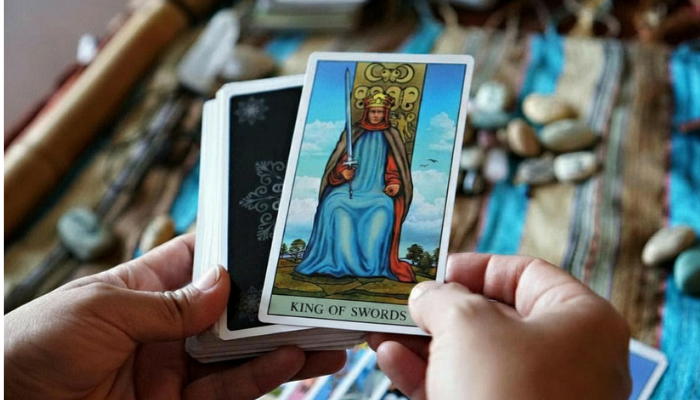
The reason court cards are so difficult is because they’re extremely context-dependent. A court card can mean several very different things OR refer to very different people, depending on the situation:
- It can represent an actual person in the querent’s life.
- It can represent the querent themselves (who they are right now, who they need to become, or who they aspire to be/not be)
- It can represent an energy or archetype that’s at play in the situation.
- It can represent a phase or approach that’s being called for.
There’s no single correct interpretation for every single situation and context. The card’s meaning is always shaped by the question, the position in the spread, the surrounding cards, and, more importantly, the human reader’s read on the person and situation in front of them.
What an AI actually does with a court card
An AI tarot tool reads a court card, it does what it always does: it pulls from a fixed set of data about their meanings. That’s not wrong, but often, it feels incomplete.
An AI tarot tool reads a court card, it does what it always does: it pulls from a fixed set of data about their meanings. That’s not wrong, but often, it feels incomplete.
So if you ask about the King of Cups, you’ll probably get something about emotional intelligence, compassionate leadership, and the ability to balance feeling and logic. All of that is included in the textbook definition of the King of Cups.
BUT here’s what the AI has difficulty determining without additional prompting:
Is this the King of Cups representing the emotionally unavailable person you’ve been trying to get through to for months? Or is it calling you to step into that calm, steady energy in how you’re handling this situation?
Both are completely valid interpretations, but only one of them is true for you, right now. And that’s what makes the reading actually useful. The best tools to discern that are genuine human intuition and the ability to contextualize the cards specifically for the person receiving the reading.
The bigger issue: tarot court cards demand the full picture AND human empathy
A skilled human tarot reader doesn’t just look at a court card in isolation. We consider it in the context of the entire spread, the question being asked, everything we know about the situation at hand, and our own human intuition. We do our best to bring empathy, experience, and innately human understanding to the table. And court cards, more than any other cards in the deck, need exactly that to be interpreted well.
What this means for you
Whether you’re learning tarot to read for yourself or looking for a reading from someone else, remember that human insight is non-negotiable for reading the cards, especially the court cards.
If you’re studying the cards, I’d strongly recommend learning from human tarot practitioners who have spent years working with these cards and can give you the grounded, empathetic, and nuanced guidance that no AI tarot tool can ever truly replicate.
El is a self-taught intuitive tarot reader from the Philippines who has been reading tarot since 2005.
- El

- El
- El
- El