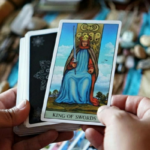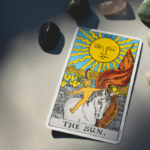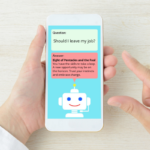
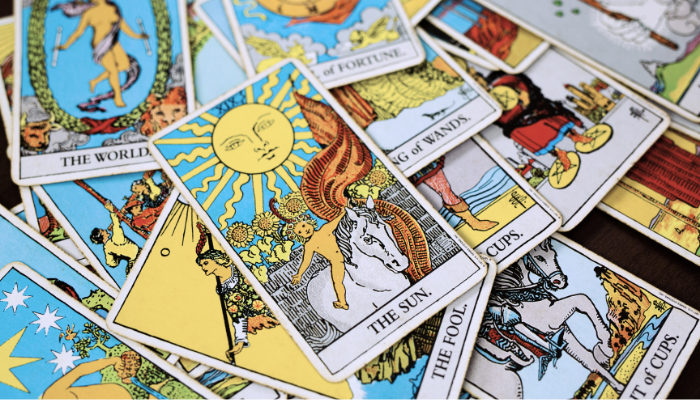
Tarot is, at its core, a set of cards adorned with symbolic pictures. These aren’t ordinary playing cards; they’re a tool for self-reflection and contemplation. Think of them as a visual aid that can help you explore your inner world.
Key Takeaways
- There are different tarot traditions, but the most popular one is the Rider-Waite Smith (RWS) Tarot.
- An RWS tarot deck is a set of 78 illustrated cards divided into the Major Arcana (22 cards) and the Minor Arcana (56 cards across four suits).
- Tarot is not just about predicting the future; it’s a tool for self-reflection, psychological insight, creative exploration, and honing your intuition.
The History and Structure of Tarot
While the exact origins of tarot are debated, it’s widely believed that tarot cards emerged in Europe around the 15th century. Initially used for games, their esoteric and divinatory applications developed later.
The most widely used system today is the Rider-Waite-Smith (RWS), first published in 1909, and it’s the tradition most beginner resources work from, including this one.
In the RWS system, there are 78 cards in a tarot deck, and they’re divided into two main sections:
- The Major Arcana: This consists of 22 cards, each representing significant life events, spiritual lessons, or archetypal figures (e.g., The Fool, The Magician, The High Priestess). These cards often carry more weight in a reading, signifying major themes and turning points.
- The Minor Arcana: This made up of 56 cards, further divided into four suits: Wands, Cups, Swords, and Pentacles. These suits correspond to the classical elements (fire, water, air, and earth) and represent more everyday aspects of life, such as relationships, emotions, challenges, and material concerns. Each suit contains numbered cards (Ace through Ten) and four court cards: Page, Knight, Queen, and King.
But RWS isn’t the only tarot tradition out there. Here are three other major systems you may encounter:
- Tarot de Marseille: The Tarot de Marseille (TdM) is actually one of the oldest tarot traditions, predating the RWS. Its Minor Arcana cards use plain suit symbols rather than illustrated scenes, which means readers rely more heavily on numerology and intuition to interpret them.
- Thoth Tarot: Created by occultist Aleister Crowley and painted by Lady Frieda Harris in the late 1930s to early 1940s, the Thoth Tarot is steeped in astrology, alchemy, and Kabbalah. It tends to suit practitioners who already have a background in those systems.
- Etteilla Tarot: The Etteilla tradition dates back to the late 18th century, created by French occultist Jean-Baptiste Alliette. It’s known historically as the first tarot system designed specifically for divination. Like the Tarot de Marseille, its Minor Arcana cards are non-scenic, relying on suit symbols rather than illustrated scenes. It remains in active use, particularly in France and Quebec.
DISCLAIMER: My own tarot practice only covers the RWS. I honestly have not studied the other systems at all, though I do have tarot reader friends who use them.
Going Beyond Fortune-Telling or “Panghuhula“
One of the most common misconceptions about tarot is that it’s solely for predicting the future or “panghuhula” as we call it in the Philippines. While some people may use them that way, what I want to emphasize here and what I do in my tarot practice is different.
Tarot can be used as a mirror, reflecting your current thoughts, feelings, and life situations. It’s less about seeing what will happen, and more about understanding what is happening, and what could happen based on your present actions and mindset. This is quite different from the usual “panghuhula“, which is why I personally never refer to myself as manghuhula.
The term “panghuhula”, comes from the word “hula”, which can literally be translated to “guess”. For me, equating tarot ONLY with “guessing” what the future will be like misses the practice’s deeper potential.

As I practice it, tarot is less about predicting a fixed future and more about providing a framework for self-discovery, psychological insight, and creative exploration. As I like to say: I lay your cards out on the table to show you the bigger picture, and help you the ideal path forward based on what you want to achieve. While my tarot readings can show you possible futures, I never present “predictions” that are set in stone.
Using tarot this way allows us to explore our present circumstances, understand our motivations, and identify potential paths forward, empowering us to take ownership of our lives rather than just blindly believing a predicted outcome.
A Tool for Self-Reflection
Tarot cards offer a unique way to tap into your intuition. Each card carries a range of meanings, and when you draw a card, your subconscious mind connects with those meanings in a way that’s relevant to your life. The images on the cards can spark insights and help you see things from a fresh perspective.
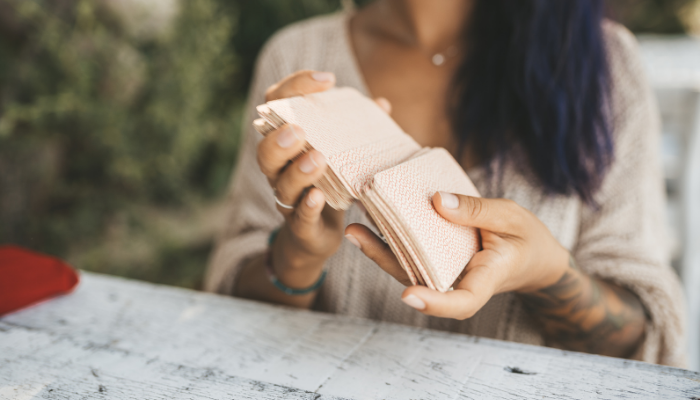
For example: imagine you’re feeling stuck in a rut at work. You draw the Three of Wands, which shows a figure on a cliff, gazing out across the horizon. This card might not tell you which job to take, but it can prompt you to consider the different possibilities and paths available to you — perhaps beyond the limits of what you normally see or do at your current job.
Understanding Your Feelings
Tarot can also be a valuable tool for understanding your emotions. Sometimes, it’s hard to put your finger on why you’re feeling a certain way. A tarot card can act as a catalyst, bringing hidden emotions to the surface.
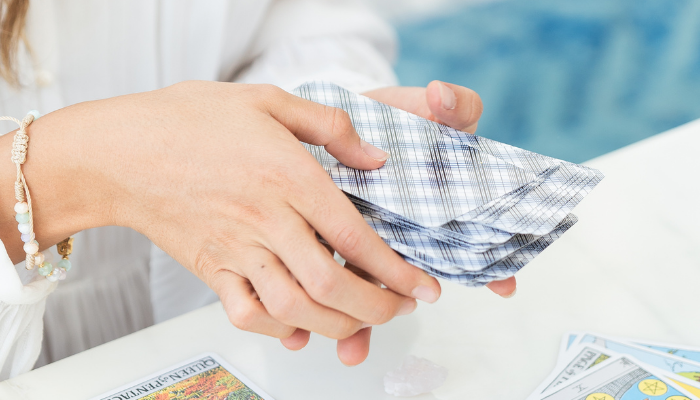
Let’s say you’re feeling anxious about a relationship. You draw a card showing a tower being struck by lightning. This card’s dramatic imagery might represent sudden upheaval or a breakdown in communication. It could help you acknowledge feelings of fear or uncertainty that you’ve been trying to suppress, prompting you to address them directly.
In essence, tarot is a tool that can help you:
- Gain clarity on a situation.
- Explore different perspectives.
- Connect with your intuition.
- Understand your emotions.
- Make more informed decisions.
It’s a journey of self-discovery, guided by the wisdom held within the cards.
El is a self-taught intuitive tarot reader from the Philippines who has been reading tarot since 2005.
- El

- El
- El
- El